Florida Perinatal Quality Collaborative
Perinatal Quality Indicators (PQI)
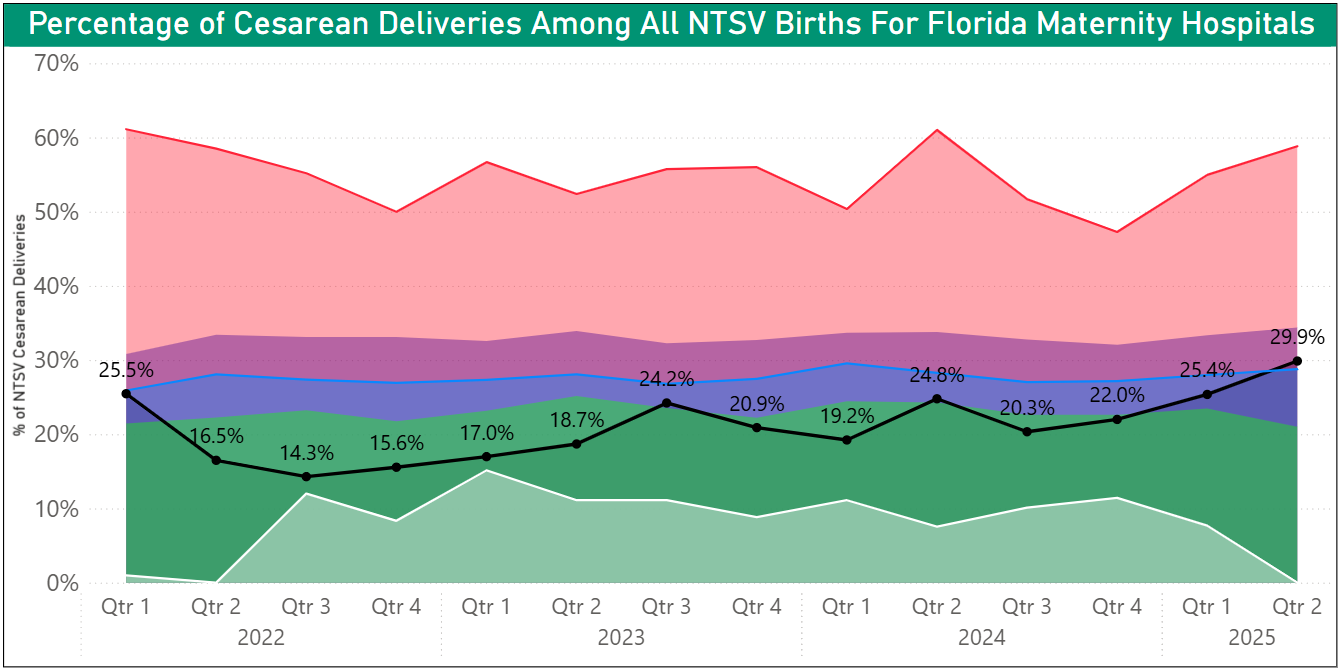
The Perinatal Quality Indicators (PQI) Initiative supports hospital quality improvement efforts by providing hospital-specific semi-annual or quarterly reports of perinatal indicators and related reports.
All Florida delivery hospitals receive a PQI report at no charge. If you would like to see your hospital report please email FPQC@usf.edu and we will connect you to your PQI liaison.
FPQC’s PQI have been adapted from measures provided by leading national groups such as the Joint Commission, National Quality Forum, Vermont Oxford Network, California Maternal Quality Care Collaborative (CMQCC), and the Leapfrog Group. The FPQC Data Advisory Committee, composed of representatives from participating hospitals and state partnering organizations, selects and revises data indicators, as well as recommends presentation format.
Quality Indicator System Training Modules
View Training Module 1: Perinatal Quality Indicators (16:29 min)
View Training Module 2: Understanding Perinatal Quality Improvement Indicator Reports (10:03 min)
You may view the training module and complete the assessment as many times as you'd like. If you have access trouble, please contact FPQC@usf.edu
FPQC Introduces the Differences in Perinatal Outcomes Dashboard to PQI Teams
FPQC held a webinar on May 31st, 2023 introducing all hospitals participating in PQI to the new Differences in Perinatal Outcomes dashboard. This dashboard helps hospitals identify differences between groups within outcomes, which will help narrow gaps in Key Perinatal Indicators across PQI facilities.
Enroll in PQI Today!
What will hospitals get from participating?
- Semi-annual or quarterly reports for current indicators
- Brief training modules on the data for hospital liaison
- FPQC support for QI efforts resulting from your hospital data
What will hospitals need to do to participate?
- Complete two online training modules
- Complete two brief surveys per year
- Work on improving your hospital’s data quality based on issues identified from your hospital’s PQI report with support from the FPQC or Florida Department of Health
Hospitals do not have to submit any additional data to the FPQC to get these reports. For more information on the initiative, please view the materials and FAQ below. Contact FPQC@usf.edu with any questions.
FAQ
-
No, hospitals do not submit data to the FPQC. Data used for the indicators comes birth certificate and inpatient hospital discharge data. Birth certificate data is provided by the Florida Department of Health (FDOH) and inpatient hospital discharge data is provided to the FPQC by the Agency for Healthcare Administration (AHCA).
-
Yes, as part of this initiative, your hospital is committing to reviewing reports and identifying areas for improvement. Your hospital should identify a quality improvement project related to the perinatal indicators.
-
Currently, there are nine (9) sets of indicators provided to hospitals. Each set contains related indicators. Following each measure is the respective source.
- Non-medically indicated deliveries—TJC: PC-01
- Nulliparous, term, single, vertex (NTSV) cesareans— TJC: PC-02
- NTSV cesarean comparative measure—TJC, SMFM guidelines
- Failed inductions of labor—FPQC/CMQCC
- Severe Maternal Morbidity—CDC/AIM
- Unexpected Newborn Complications—CMQCC
- Severe Hypertension/Preeclampsia—ACOG AIM
- Obstetric Hemorrhage—ACOG AIM
- Neonatal Abstinence Syndrome—FDOH
-
Currently hospital receive their reports bi-annually (June and December/January), and can access their reports live through Dashboard, with the option to print out reports. If your hospital would like to access the report more frequently, your hospital liaison may access the report quarterly online through their USF login credentials.
-
FPQC will gladly assist your hospital team with interpreting your hospital’s data reports, improving your hospital’s data quality, identifying an area for improvement in patient safety, and referring you to resources to help your hospital implement a quality improvement project.
-
Download a sample Indicator Report here.
-
Indicators in PQI have different reporting periods, with some being more current than others.
-
Additional Information
-
- Assessing hospital differences in low-risk cesarean delivery metrics in Florida (Oburne et al. 2023): Uses hospital inpatient and birth certificate data to examine the impact on between-hospital differences for national hospital metrics for low-risk cesarean rates. The article demonstrates that rates using birth certificate data alone are more timely and closely approximate to those of other national metrics at a hospital level.
- Race and Ethnicity Misclassification in Hospital Discharge Data and the Impact on Differences in Severe Maternal Morbidity Rates in Florida (Reid et al. 2023): Demonstrates substantial misclassification of race/ethnicity with hospital inpatient data compared to birth certificate data, especially for Non-Hispanic-American Indian/Native American and Non-Hispanic-Asian and Pacific Island women. These differences can alter Severe Maternal Morbidity rate estimates at state and hospital levels.
- Multilevel factors associated with length of stay for neonatal abstinence syndrome in Florida’s NICUs: 2010–2015 (Reid et al. 2021): Length of hospital stay for Neonatal Abstinence Syndromes (NAS) in Florida varies widely across NICUs. Longer hospital stays related to varying infant/maternal factors as well as lower hospital volume of NAS admissions.
- Hospital Variations in Unexpected Complications Among Term Newborns (Sebastiao et al. 2017): Examines the impact of hospital and patient factors in Florida on “unexpected newborn complications” and demonstrates that hospital factors are the major contributor suggesting potential opportunities for improvement.
- Maternal and Hospital Characteristics of Non-Medically Indicated Deliveries Prior to 39 Weeks (Womack et al. 2014): Uses hospital inpatient and birth certificate data to identify maternal/hospital factors contributing to early term elective deliveries. Hospital education, protocols, and enforced policies can help to reduce NMI births.
-
- Interactive Workshop: Master your PQI Report (June 23, 2025)
-
- AdventHealth Altamonte
- AdventHealth Celebration
- AdventHealth Daytona Beach
- AdventHealth Fish Memorial
- AdventHealth Heart Of Florida
- AdventHealth Ocala
- AdventHealth Orlando
- AdventHealth Port Charlotte
- AdventHealth Riverview
- AdventHealth Sebring
- AdventHealth Tampa
- AdventHealth Waterman
- AdventHealth Wesley Chapel
- AdventHealth Winter Park
- AdventHealth Zephyrhills
- Ascension Sacred Heart Emerald Coast
- Ascension Sacred Heart Pensacola
- Ascension St. Vincent's Clay County
- Ascension St. Vincent's Medical Center Southside
- Baptist Hospital
- Baptist Hospital of Miami
- Baptist Medical Center Beaches
- Baptist Medical Center Clay
- Baptist Medical Center Jacksonville
- Baptist Medical Center South
- Bethesda Health
- Boca Raton Regional Hospital
- Broward Health Coral Springs
- Broward Health Medical Center
- Cape Coral Hospital
- Cleveland Clinic Indian River Hospital
- Cleveland Clinic Tradition Hospital
- Good Samaritan Medical Center
- Halifax Health
- HCA Florida Brandon Hospital
- HCA Florida Capital Regional Medical Center
- HCA Florida Citrus Memorial Hospital
- HCA Florida Fort Walton-Destin Hospital
- HCA Florida Gulf Coast Hospital
- HCA Florida Kendall Hospital
- HCA Florida Lawnwood Hospital
- HCA Memorial Hospital Jacksonville
- HCA Florida Mercy Hospital
- HCA Florida North Florida Hospital
- HCA Florida Northwest
- HCA Florida Oak Hill Hospital
- HCA Florida Orange Park Hospital
- HCA Florida Osceola Hospital
- HCA Florida Oviedo Medical Center
- HCA Florida Palms West Hospital
- HCA St Lucie Medical Center
- HCA Florida St. Petersburg Hospital
- HCA Florida Trinity Hospital
- HCA Florida University Hospital
- HCA Florida West Hospital
- Health First Holmes Regional Medical Center
- Health First's Viera Hospital
- HealthPark Medical Center
- Homestead Hospital
- Jackson Hospital
- Jackson Memorial Hospital Um
- Jackson North Medical Center
- Jupiter Medical Center
- Lakeland Regional Medical Center
- Lakewood Ranch
- Lower Keys Medical Center
- Manatee Memorial Hospital
- Mease Countryside Hospital
- Memorial Hospital Miramar
- Memorial Hospital West
- Memorial Regional Hospital
- Morton Plant Hospital
- Mount Sinai Medical Center
- NCH North Naples Community Hospital
- North Okaloosa Medical Center
- Orlando Health Bayfront Hospital
- Orlando Health Lake Mary Hospital
- Orlando Health Winnie Palmer Hospital for Women & Babies
- Palmetto General Hospital
- Parrish Medical Center
- Santa Rosa Medical Center
- Sarasota Memorial Hospital
- Sarasota Memorial Hospital – Venice Campus
- South Florida Baptist Hospital
- South Lake Hospital
- South Miami Hospital
- St Joseph's Hospital - North
- St Joseph's Hospital - South
- St Joseph's Women's Hospital
- St Mary's Medical Center
- Tallahassee Memorial Hospital
- Tampa General Hospital
- Tampa General Hospital Spring Hill
- UCF Lake Nona Medical Center
- UF Health Jacksonville
- UF Health North
- UF Health Shands Hospital
- UF Health St. John's
- Wellington Regional Medical Center
- West Boca Medical Center
- West Kendall Baptist Hospital
- Winter Haven Women's Hospital