Safe Reduction of Primary Cesarean Birth Initiative Toolbox
-
FPQC Safe Reduction of Primary Cesarean Birth Key Resources
FPQC Safe Reduction of Primary Cesarean Birth Data Resources
Patient-Level Data Collection Form - Coming Soon
Hospital-Level Data Collection Form - Coming Soon
Safe Reduction of Primary Cesarean Birth Baseline Data Form - Coming Soon
Measurement Grid - Coming Soon
Safe Reduction of Primary Cesarean Birth Data Collection Instructions and Tools - Coming Soon
-
1a. Mobilize a QI Team of administrators, nurses, physicians, nurse midwives to lead efforts to promote vaginal birth
Evidence and Rationale
Quality-Improvement Strategies for Safe Reduction of Primary Cesarean Birth (ACOG Committee Statement 17, 2025). ACOG recommendations for reducing cesarean births including respectful care in labor and birth, shared decision making, and clinician training on labor support methods.
National Partnership for Maternal Safety: Consensus Bundle on Safe Reduction of Primary Cesarean Births- Supporting Intended Vaginal Births (Lagrew et al. 2018). The National Partnership for Maternal Safety recommends reducing cesarean births through multiple quality initiatives including improving unit culture, optimizing patient and family engagement, and provider training on labor support and supporting vaginal birth.
Safe Reduction of Nulliparous, Term, Singleton, Vertex Cesarean Delivery Rates Using Multidisciplinary Quality Improvement Efforts (McGee et al., 2026). A quality improvement project at a tertiary care hospital reduced cesarean births without increasing neonatal complications through data sharing, standardizing oxytocin administration, chart audits, patient centered decision aids and labor support protocols, and standardized algorithms for determining need for primary cesarean section.
Project Planning and Hospital Charter Examples
NTSV Patient Identification
NTSV Magnet Example Lee Health - Magnet for patient door
Stork Door Banner – NTSV signage for patient door
1b. Promote patient and family engagement through accessible, evidence-based birth education with an emphasis on informed consent & shared decision making
Evidence and Rationale
Partnering with Doulas in Clinical Settings (ACOG Committee Statement 31, 2026). ACOG supports creating respectful labor support teams with doulas and using strategies to foster open and positive communication.
Effective Patient-Physician Communication (ACOG Committee Statement 23, 2025). ACOG recommends using relationship centered communications skills and interpreters when needed to support effective patient-physician communication and shared decision making.
Continuous Labor Support Position Statement (AWHONN, 2026). AWHONN supports the impact nurses make through labor support. Incorporates Respectful Maternity Care and doula integration during labor and birthing.
Intrapartum doula support and cesarean delivery rates: A systematic review and meta-analysis (Dias et al., 2025). Article demonstrates the impact doula support can make, lowering cesarean birth rates.
A meta-analysis on the impact of doula care on Cesarean section rates (Achebe et al., 2024). Analysis of randomized controlled trials demonstrate a decrease in rates of Cesareans.
Birth Preferences
1c. Provide interdisciplinary perinatal team education on strategies that maximize the likelihood of a safe vaginal birth
Evidence and Rationale
Safe Reduction of Nulliparous, Term, Singleton, Vertex Cesarean Delivery Rates Using Multidisciplinary Quality Improvement Efforts (McGee et al., 2026)
Continuous Labor Support Position Statement (AWHONN, 2026)
Intrapartum Fetal Heart Rate Monitoring: Interpretation and Management (ACOG Clinical Practice Guideline 10, 2025). Overview of Fetal heart rate monitoring nomenclature and recommended interventions by fetal heart rate category.
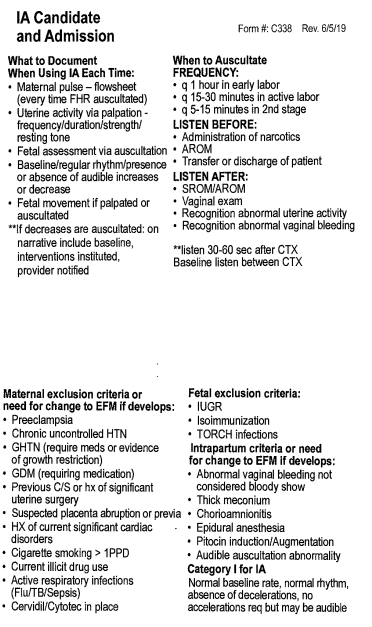
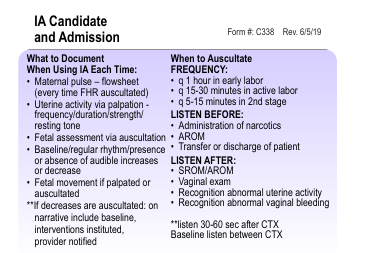
Fetal Heart Monitoring (AWHONN Position Statement, 2024). AWHONN National Standards for EFM. Includes intermittent Auscultation.
Nonpharmacologic Labor Support
Colorado PQC Hands on Labor Support Module – 6 hour Labor Support PPT
Labor Support Cart – Labor Supplies/Patient support tools organized for hospital consideration
Labor Skills Workshop – FPQC PPT & recordings featuring Jessica Brumley, CNM
UF Doula Friendly Guidelines – Example policy from UF for Doula Integration into OB services including cesarean birth. Doulas are part of team and not a visitor.
Fetal Monitoring Assessment Education
AWHONN Fetal Monitoring training programs – National Course developed in 1992 to training RNs, CNMs, MDs on Fetal Heart Rate Monitoring skills. Cost involved for both Intermediate in person training along with the Advanced Virtual course
ACOG Fetal Monitoring Training - ACOG online training webinar for fetal heart rate interpretation. 4 hours of CME credits. Cost involved.
PQI Intermittent Auscultation (IA)Training Course. Developed by Perinatal Quality Improvement (PQI) in partnership with AWHONN & ACNM experts, this 45 min simulation-based course provides training on how to appropriately perform and interpret Intermittent Auscultation (IA) for low-risk laboring patients. Cost involved.
-
2a. Implement policies, protocols, and support tools for women who present in latent (early) labor to safely encourage early labor at home or in hospital
Evidence and Rationale
First and Second Stage Labor Management (ACOG Clinical Practice Guideline No. 8)
Use of an early labor lounge to promote admission in active labor (Paul et al. 2017)
Latent Labor
Walking Path Examples
Cervical Ripening Patient Education
Cervical Ripening Patient Education - BayCare (Includes page in Spanish)
Hospital Triage Protocol Examples
2b. Implement standardized policies and protocols to support physiologic labor
Evidence and Rationale
Approaches to Limit Intervention During Labor and Birth (ACOG Committee Opinion No 766)
Fetal Heart Monitoring (AWHONN Position Statement, 2024)
Intrapartum Anesthesia and Analgesia (AWHONN Clinical Practice Guideline, 2020)
Continuous Labor Support (AWHONN Position Statement, 2018)
Implementing Labor Induction with a Commitment to Physiologic Birth (ACNM Position Statement, 2025)
Evaluating the Impact of the Second Stage and Pushing Duration on Maternal and Neonatal Outcomes: a systematic review and meta-analysis (Aboukhater et al. 2025)
Intermittent Auscultation for Intrapartum Fetal Heart Rate Surveillance (Ostrem‐Niemcewicz et al. 2026)
CMQCC Key Strategies – Supporting vaginal birth, using data to drive reduction in Cesareans, Midwifery Integration, improved safety across birth settings, doula integration.
Hospital Protocols on Fetal Monitoring and Intermittent Auscultation
TGH Intermittent Auscultation Badge Cards / Badge Buddy
Labor Support Resources
2c. Implement policies and protocols for induction of labor
Evidence and Rationale
AWHOHN Cervical Ripening and Labor Induction and Augmentation 6th Edition
Cervical Ripening in Pregnancy (ACOG Clinical Practice Guideline 9, 2025)
Methods for the induction of labor: efficacy and safety (Sanchez-Ramos et al. 2024)
Prevention of Group B Streptococcal Early-Onset Disease in Newborns (ACOG Committee Opinion No. 797, 2019) There are no data to suggest that artificial rupture of membranes increases the risk of neonatal disease when appropriate intrapartum antibiotic prophylaxis is given and, therefore, amniotomy is reasonable to perform if clinically indicated.
Early amniotomy after cervical ripening for induction of labor: a systematic review and meta-analysis of randomized controlled trials (De Vivo et al. 2020)
Bishop Scores (Wormer et al., 2024)
Hospital Examples of Cervical Ripening Policies
Patient Facing Documents on Induction of Labor
-
3a: Implement standards and checklists for prevention, diagnosis, and management of failed induction, arrest of labor, and malposition
Evidence and Rationale
First and Second Stage Labor Management (ACOG Clinical Practice Guideline No. 8, 2024)
Quality Improvement Strategies for Safe Reduction of Primary Cesarean Birth (ACOG Committee Statement No. 17, 2025)
Pre-Cesarean Checklists
Labor Management Tools
CMQCC Appendix N – Algorithm for Management of Second Stage of Labor
Note: Immediate pushing may be indicated even without an urge to push. An individualized approach to the start of pushing is recommended.
Operative vaginal delivery: checklists for performance and documentation (SMFM Special Statement, 2020)
Management of Malposition
CMQCC Appendix G – Guide to Second Stage Management of Malposition
Manual Positioning Videos
3b: Implement standardized assessment and response to indeterminate and abnormal fetal heart rate patterns
Evidence and Rationale
Intrapartum Fetal Heart Rate Monitoring: Interpretation and Management (ACOG Clinical Practice Guideline No. 10, 2025)
Fetal Heart Monitoring (AWHONN Position Statement, 2024)
A Standardized Approach for Category II Fetal Heart Rate with Significant Decelerations: Maternal and Neonatal Outcomes (Shields et al., 2018)
Intrapartum management of category II fetal heart rate tracings: towards standardization of care (Clark et al., 2013)
When Evidence Fails to Change Practice: Examining the Persistence of Continuous Fetal Monitoring (De Vries et al., 2025)
Category II Algorithm Examples
Obstetrics Initiative Category II Fetal Heart Rate Tracing Management Algorithm
CMQCC Appendix Q – Algorithm for the Management of Intrapartum Fetal Heart Rate Tracings
3c: Implement a workflow process for shared decision-making during labor
Evidence and Rationale
Informed Consent and Shared Decision-Making in Obstetrics and Gynecology (ACOG Committee Opinion No. 819, 2021)
Shared Decision-Making in Midwifery Care (ACNM Position Statement, 2022)
Shared Decision-Making in Perinatal Care (Breman et al., 2024)
Effect of TeamBirth on Patient Trust and Autonomy During Childbirth in Oklahoma (Griffith et al., 2025)
TeamBirth
SHARE Approach
CHOICEs Tool