Learning Environment
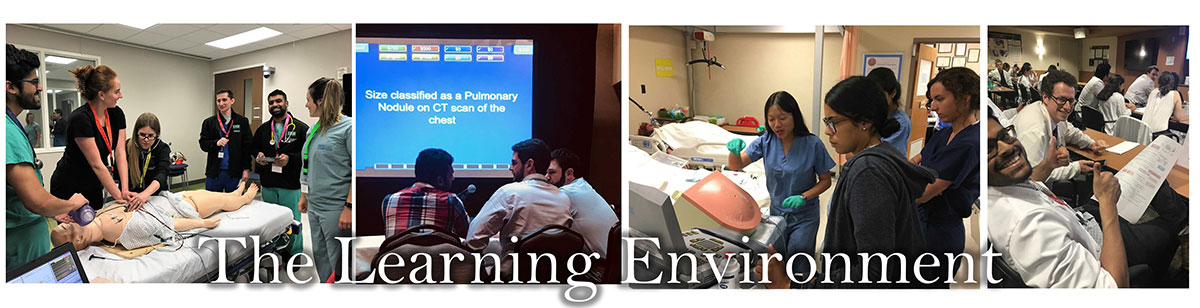
The USF Internal Medicine Residency Program fosters a dynamic and supportive learning environment centered on interactive didactics, simulation training, and strong faculty mentorship. Residents participate in diverse educational formats—from workshops in ECGs, CXRs, ABGs, documentation, and coding, to journal clubs, board review, quality‑improvement sessions, and playful yet high‑yield “Jeopardy”‐ or Pictionary‐style reviews. During inpatient rotations at Tampa General Hospital, Moffitt Cancer Center, and the James A. Haley Veterans’ Hospital, residents participate in weekday noon conferences that enrich clinical learning and promote collegial discussion. When on their longitudinal continuity clinic blocks, residents attend a dedicated academic half day on Friday afternoons, ensuring protected time for board review, workshops, and ambulatory-focused education. Simulation training at CAMLS and the VA Simulation Center sharpens procedural, ACLS/BLS, ultrasound, and code leadership skills. Faculty who are award‐winning educators foster mentorship, professional growth, and a resident‑centered culture. With resources like “Big Picture” board guides and a four‑day in‑house board review for PGY‑3s, the program supports a 97% three‑year board pass rate—evidence of its effective, resident‑focused learning approach.
Board Review
All residents participate in board review didactics during the ambulatory block academic half-day. Question and answer style board review occurs weekly at each hospital site. Our program creates “Big Picture” study guides for each resident to follow along during didactics. Third year residents are provided an in-house 4- day intensive board review. The combination of exceptional residents and longitudinal learning of material is reflected in our 99% four-year board pass rate.
X + Y
All categorical residents participate in the X+Y block model, or 6 + 2 model. After 6 weeks of core rotations (a mixture of wards, ICU, electives, and nights), our residents begin their 2-week block of ambulatory clinics. During the 2-week ambulatory block, continuity clinic is accompanied by exposure to outpatient subspecialties. Residents appreciate the dedicated exposure to ambulatory medicine this schedule affords.
Simulation
Simulation is integrated in the training in every year at the James A. Haley Veteran’s Hospital Simulation Center or the Center for Advanced Medical Simulation & Learning (CAMLS). Simulation training is used for procedure training, ACLS/BLS recertification, code team leader communication skills, and point-of-care ultrasound training (POCUS).
Dedicated Faculty
Our faculty are outstanding and dedicate themselves to teaching, mentorship, and resident professional development. The department is ranked in the top 4% by the AAMC ranking for undergraduate medical education preparation for residency. The Internal Medicine 3rd Year Clerkship consistently receives the award for “Best Clerkship” voted on by the graduating medical students. This is truly a reflection of dedicated clerkship faculty and the education provided on the ward services by attendings and residents.