Flow Cytometry Core
Dealing with Multiple Fluorochromes
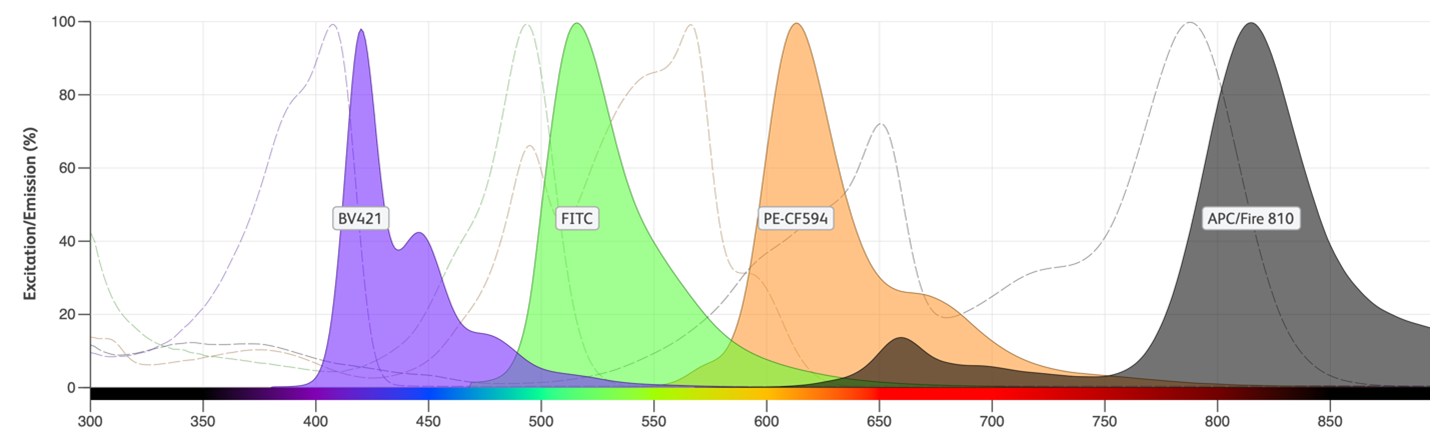
Multi parameter Flow Cytometry is based on that we label the multiple parameters each with a differently colored fluorochrome. The problem is that the fluorochromes don’t typically admit just one single color. For example, a green fluorochrome like FITC is mostly green, but it also emits some yellow or a little orange light. So, even in an absence of a yellow fluorochrome, some yellow light will be detected. That is a problem if you are planning on using a yellow dye in the same experiment…
So, what to do? Easiest for a simple experiment with max a handful of colors is to pick the fluorochromes far from each other. Excited by different lasers, far apart on the spectrum, problem is averted.
If it cannot be averted, traditionally we perform a mathematical correction to make up for the interference. This is called COMPENSATION. For example, if I record a FITC only sample and establish that if I detect 100 units of green color, I should expect FITC to also to contribute 10 units in the yellow and 2 units in the orange detector. So, in the experiment I’ll take these contaminating 10 and 2 out of the signal from the affected detectors.
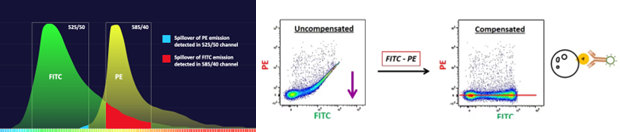
Next level approach is SPECTRAL UNMIXING. Compensation works with an instrument set up where each fluorochrome has its designated detector. For example, blue excited green detector for FITC, violet excited blue detector for DAPI. For spectral unmixing you monitor the whole spectrum and establish the fingerprint that every fluorochrome in the experiment exhibits. Then, when recording the sample, you will see a composite spectrum and calculate how many of this and how many of that fluorochrome do you have to add together to match what you actually observed. This means a lot more expensive detectors and a lot more computing. What you gain is multi-fold. For one, you can detect massively more different fluorochromes in the same experiment. This is how the field moved from the high ten color panels to 50 color panels. Two, you increase the sensitivity. Instead of throwing away detected light that is not in the designated detector, all colors that the fluorochrome emitted is now counted. Three, no surprise fluorochromes. It happens regularly that I discuss with a user what reagents will be in the experiment, just that they would show up swapping the agreed fluorochrome to something that the machine does not have detector for. Spectral instruments monitor the whole light spectrum, so there will always be detector that sees the color. Finally, you can designate unstained cell as a fluorochrome, establish its auto fluorescent signature and take that out of the measurement, drastically reducing the background.
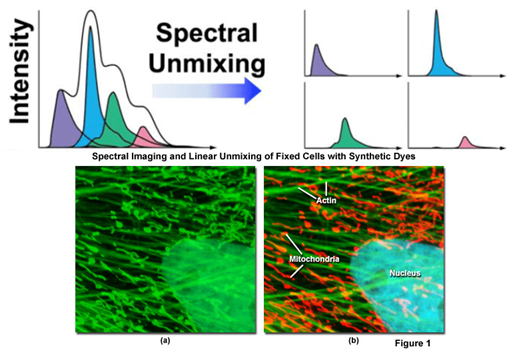
Microscopic illustration of spectral unmixing. Three similar colored dyes were used to stain the sample, then pixel by pixel the data was unmixed and artificially different colors were assigned to the different dyes.