Graduate Program
Doctor of Nursing Practice Overview
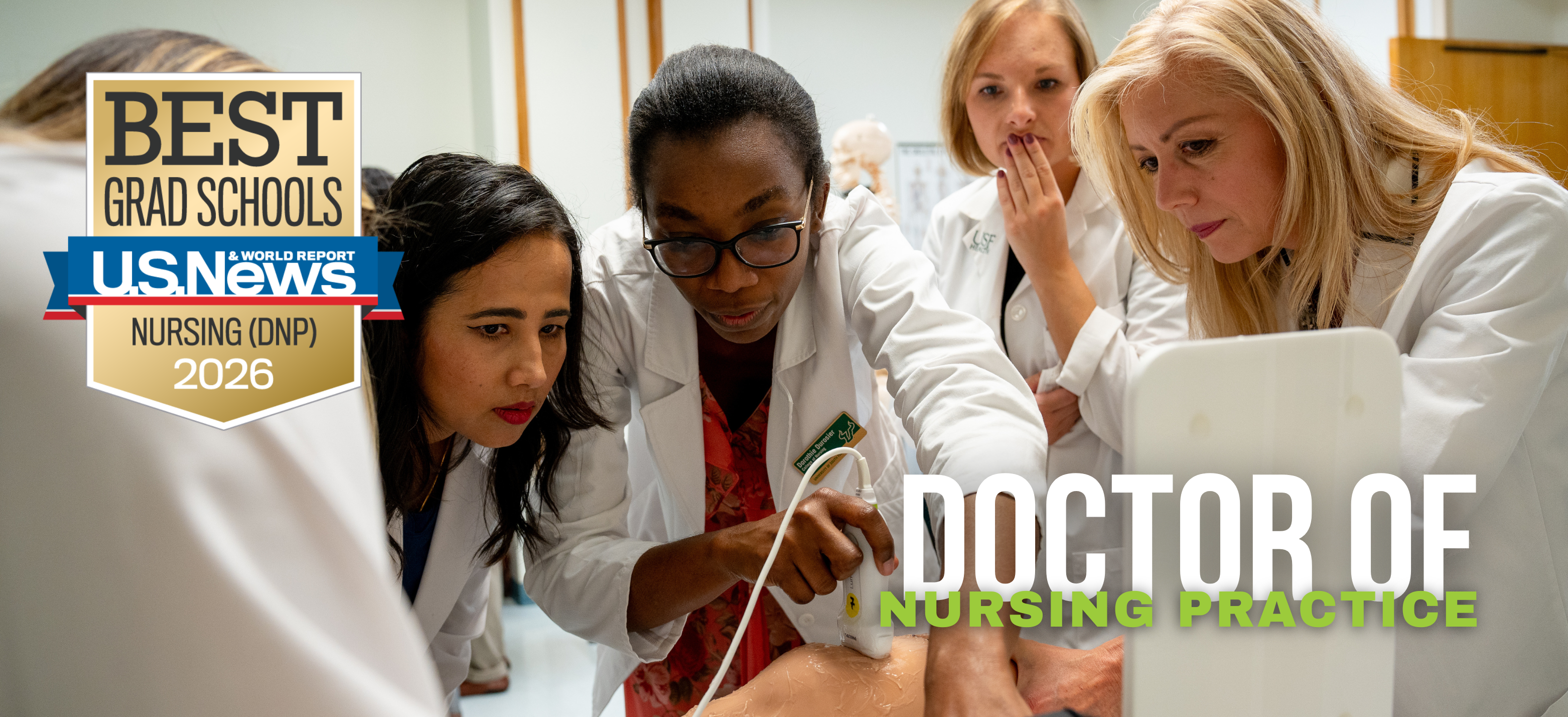
Advance Your Impact with a Doctor of Nursing Practice from USF
The Doctor of Nursing Practice (DNP) is the highest practice-focused degree in nursing, preparing graduates with advanced knowledge and clinical expertise to improve patient and population health outcomes.
The College of Nursing recruits a diverse, highly motivated applicant pool. Admission considers multiple factors to evaluate potential for success at the doctoral level. The DNP program offers two entry options: post-baccalaureate (BSN to DNP) and post-master’s (MSN to DNP).
Graduates are prepared to apply advanced clinical judgment, systems thinking, and evidence-based strategies to enhance care quality and drive positive outcomes.
Accreditations – Visit our Accreditation page to learn more.
DNP vs. PhD Comparison
What is the difference between the PhD in Nursing Science and the Doctor of Nursing Practice (DNP)?
BSN-DNP Concentrations
-
I am not sure which concentration is right for me. Can you help?
We encourage you to complete our Specialty Navigator Survey to help identify the concentration that best aligns with your interests and career goals: https://usf.az1.qualtrics.com/jfe/form/SV_01iSOlIi130nm8m
I am an international student. Can I apply to the MSN or DNP program?
International students may face additional restrictions related to course delivery formats and visa requirements. Due to federal regulations governing online coursework, students on an F-1 visa are not eligible for admission to the MSN or DNP programs.
How is the USF Nurse Practitioner program accredited?
Please visit the College of Nursing Accreditation webpage for detailed information regarding program accreditation. https://health.usf.edu/nursing/college-overview/accreditation.
Is this an online program?
The USF College of Nursing graduate clinical programs are offered in a hybrid format. Students are required to come to campus at various points throughout the program.
How often will I need to come to campus?
Students should expect to attend on-campus classes or activities approximately once per month.
Does the program have a summer break?
The College of Nursing graduate programs continue through the summer semester.
Can I transfer courses from another graduate nursing program?
Yes, transfer credits may be accepted; however, certain limitations apply. Once you have been fully admitted, please contact your academic advisor to begin the transfer credit evaluation process.
** Please note:
USF College of Nursing evaluates transfer courses on a credit-for-credit basis.
Courses completed in quarter hours must meet the semester-hour equivalency requirements
A maximum of 12 transfer credits may be accepted.
Clinical courses are not eligible for transfer.
Approval of transfer credits is at the discretion of the Program Director.
Can I switch from the MSN program to the DNP program?
The DNP is a separate degree program. Students admitted to an MSN program who wish to pursue a DNP degree must submit a new application and complete the admissions process for the DNP program.
Can I pursue two concentrations at the same time?
Students may enroll in only one concentration at a time.
Can I apply to both the MSN and DNP programs?
Applicants may apply to only one degree program, MSN or DNP per application cycle.
What are my options if I want an additional certification?
Students interested in obtaining an additional certification may pursue a post graduate certificate.
If I do not meet the minimum overall GPA or nursing GPA requirement, can an exception be made?
Admission requirements are established by the College of Nursing and exceptions are generally not granted. Applicants who do not meet the minimum GPA requirements may wish to explore programs at institutions with flexible admission criteria.
I graduated from my BSN program several years ago and no longer have contact with nursing faculty or clinical instructors. Can someone else write my recommendation letter?
If you are unable to obtain a recommendation from a nursing faculty member or clinical instructor, you may submit a letter from a nursing supervisor or an advanced healthcare provider (APRN, MD, DO, or PA) who can speak to your academic ability, clinical competence, and commitment.
Letters from family members, friends, coworkers, or personal acquaintances are not accepted.
Does the program require the GRE?
The GRE is not required for admission. However, applicants may choose to submit competitive GRE scores taken within the past five years as supplemental information to support their application.
Do I need to submit both the USF Graduate Application and the NursingCAS application?
Yes. Applicants must submit both the USF Graduate Application and the NursingCAS application to be considered for admission.
Please note that all supporting application materials must be submitted directly to NursingCAS, including 3 letters of recommendation, resume, RN license, and official transcripts from all colleges and universities attended. You do not need to submit these supporting documents separately to the USF Office of Graduate Admissions.
What does a "Verified" status in NursingCAS mean?
A "Verified" status indicates that NursingCAS has completed its review of your application. During this process, NursingCAS compares your official transcripts to your self-reported coursework, calculates your GPA, and confirms receipt of required application materials, such as letters of recommendation.
Please note that a Verified status does not indicate admission to the program; it only confirms that NursingCAS has processed your application for review by the College of Nursing.
I am having issues submitting my transcripts to NursingCAS. Can you assist?
For assistance with transcript submission, please contact NursingCAS directly. The customer support team can help with transcript requests, document processing, and application-related questions.
Phone: 617-612-2880
Am I required to attend orientation?
Yes. The College of Nursing Graduate orientation is mandatory for all admitted students. Be sure to RSVP for the College of Nursing orientation through your Confluence onboarding page. The orientation offered by the USF Office of Graduate Studies is optional.
Am I required to receive the COVID-19 vaccine?
The COVID-19 vaccine is not required by USF or the College of Nursing. However, individual clinical partner sites may require students to be vaccinated in order to participate in clinical experiences. If you need to request a religious or other exemption, please contact con-gradcompliance@usf.edu.
-
Applicants must meet USF graduate admission requirements in addition to the nursing program's requirements. BSN-DNP admission criteria include:
- Bachelor of Science in Nursing or an equivalent degree from a foreign institution.
- Must meet USF Graduate Admissions overall GPA requirements
- A bachelor’s degree satisfying at least one of these criteria:
- “B” average (3.00 on a 4.00 scale) or better in all work attempted while registered as an undergraduate student working toward a bachelor’s degree
- “B” average (3.00 on a 4.00 scale) or better in all work attempted while registered as a graduate student working for a graduate degree
- A bachelor’s degree with a “B” average or better and a previous graduate degree with a “B” average or better.
- Note: In cases where an applicant has a bachelor’s and a graduate degree at the time of admission, the credentials and GPA of the graduate degree will be the determining factor for admission.
- The equivalent bachelor’s and/or graduate degrees from a foreign institution.
- Bachelor’s degrees from institutions in the European Higher Education Area (EHEA) are considered equivalent based on the Bologna Accord. For applicants with a 3-year bachelor’s degree with less than 120 hours that was received at a non-Bologna Accord institution, we require a transcript evaluation from a NACES member to confirm equivalency.
- A bachelor’s degree satisfying at least one of these criteria:
- Current, unencumbered license as a registered nurse in Florida by October 30th. Students must have an RN license in the United States prior to admission.
- 3.0 minimum Nursing GPA
- Completion of an undergraduate-level Statistics course (3 credits) with a grade of B or better before the start of the program.
- 1 year (12 months) minimum of full-time experience in critical care (intensive care unit) or high-acuity patient care before the start of the program to meet professional practice requirements for clinical placement. Clinical experience will be evaluated on a case-by-case basis by the faculty (Note: This requirement is for Adult Gerontology Acute Care concentration only.)
- Three (3) letters of recommendation indicating potential for graduate study from individuals who can attest to the applicant’s academic ability, clinical competence, and commitment.
- These letters must be from a current or prior nursing faculty member or clinical instructor, a nursing supervisor, and an advanced healthcare provider (APRN, PA, MD, or DO).
- Applicants who are not able to obtain a letter of recommendation from a current/prior nursing faculty member or clinical instructor may substitute with another letter from a second nursing supervisor or advanced practice healthcare provider.
- Letters from acquaintances, friends, or family are not acceptable for submission
- Current resume or curriculum vitae.
- It is recommended, but not required, to submit competitive GRE scores taken within the last five years
Important Application Notices:
Please review the Prior Conduct Requirements section.
-
Applicants must meet USF graduate admission requirements in addition to the nursing program's requirements. MSN-DNP admission criteria include:
- Bachelor of Science in Nursing or an equivalent degree from a foreign institution.
- Master of Science in Nursing (MSN) from an accredited institution with a CCNE or ACEN-accredited nursing program.
- Must meet USF Graduate Admissions overall GPA requirements
- A bachelor’s degree satisfying at least one of these criteria:
- “B” average (3.00 on a 4.00 scale) or better in all work attempted while registered as an undergraduate student working toward a bachelor’s degree
- “B” average (3.00 on a 4.00 scale) or better in all work attempted while registered as a graduate student working for a graduate degree
- A bachelor’s degree with a “B” average or better and a previous graduate degree with a “B” average or better.
- Note: In cases where an applicant has a bachelor’s and a graduate degree at the time of admission, the credentials and GPA of the graduate degree will be the determining factor for admission.
- The equivalent bachelor’s and/or graduate degrees from a foreign institution.
- Bachelor’s degrees from institutions in the European Higher Education Area (EHEA) are considered equivalent based on the Bologna Accord. For applicants with a 3-year bachelor’s degree with less than 120 hours that was received at a non-Bologna Accord institution, we require a transcript evaluation from a NACES member to confirm equivalency.
- A bachelor’s degree satisfying at least one of these criteria:
- Current, unencumbered license as a registered nurse in Florida by October 30th. Students must have an RN license in the United States prior to admission.
- Advanced Practice Nurse (APRN) licensure is required before completion of the first semester in the program. Students who have already earned their APRN license before applying are considered competitive applicants.
- National certification in an area of advanced practice is required.
- 3.0 minimum Nursing GPA
- Completion of an undergraduate-level Statistics course (3 credits) with a grade of B or better before the start of the program.
- Three (3) letters of recommendation indicating potential for graduate study from individuals who can attest to the applicant’s academic ability, clinical competence, and commitment.
- These letters must be from a current or prior nursing faculty member or clinical instructor, a nursing supervisor, and an advanced healthcare provider (APRN, PA, MD, or DO).
- Applicants who are not able to obtain a letter of recommendation from a current/prior nursing faculty member or clinical instructor may substitute with another letter from a second nursing supervisor or advanced practice healthcare provider.
- Letters from acquaintances, friends, or family are not acceptable for submission
- Current resume or curriculum vitae.
- It is recommended, but not required, to submit competitive GRE scores taken within the last five years.
Important Application Notices:
Please review the Prior Conduct Requirements section.
-
The BSN to DNP program builds on baccalaureate-level nursing competencies, allowing students to gain the skills needed for advanced practice while completing the requirements for the DNP degree.
Available BSN to DNP Concentrations:
All BSN to DNP students complete didactic and practicum experiences aligned with the AACN’s Essentials of Doctoral Education for Advanced Nursing Practice. Nurse Practitioner students also meet NP Core Competencies and population-specific competencies for their practice area. Graduates of the NP concentrations are eligible for national certification.
For full details, please refer to the Graduate Catalog.
-
The post-master’s DNP program builds on master’s-level competencies for advanced practice nurses, preparing graduates to apply advanced clinical judgment, systems thinking, and expanded responsibility in planning, implementing, and evaluating evidence-based strategies to improve individual and population health outcomes.
All students complete didactic and practicum experiences aligned with the AACN’s Essentials of Doctoral Education for Advanced Nursing Practice. The program requires a minimum of 31 credits, including at least 8 practicum credits and 4 project credits, all of which must be completed in Florida. Practicum hours directly support the DNP project and may include direct patient care, immersion experiences, or other clinical activities approved by the DNP Director.
The program follows a lock-step plan and course sequence. Students receive their specific plan upon accepting admission.
For full details, please refer to the Graduate Catalog.
-
Applicants who meet the admission requirements should complete the following steps:
Submit a USF Graduate Admissions Application
For questions, contact the USF Graduate Admissions Office at (813) 974-3350, gradadmissions@usf.edu or visit the website.
Note: Do not upload supplemental documentation (e.g., test scores, transcripts, personal statements) in this application.
The university application deadline for applicants pursuing a master degree in the fall semester is February 15th. Applicants submitting the USF application this date should selected the next available fall term on the application. The Nursing Admissions Team will backdate your USF application to correct term of entry if you are selected for admission.
Submit a NursingCAS Application
Submit all required documentation through NursingCAS, including official transcripts from all colleges/universities attended, letters of recommendation, Florida Registered Nurse license, and resume.
For questions, contact NursingCAS customer service at (617) 612-2880 or support@nursingcas.myliaison.com.
The College of Nursing Admissions Team reviews NursingCAS applications once they reach “Verified” status. Verification begins after all required materials are received and posted in NursingCAS. Be sure to monitor your application by logging in and using the “Check Status” tab on your NursingCAS dashboard.
NursingCAS applications are reviewed by the College of Nursing Admissions Team once the "Verified" status is reached in NursingCAS. The verification process begins once all application items are received and posted in NursingCAS. It is important to check your application by login to your application and using the "Check Status" tab on the NursingCAS dashboard.
International Admissions
Foreign Transcripts: Coursework and degrees completed outside the U.S. require a course-by-course evaluation from a USF Graduate School–approved agency. The Florida Board of Nursing maintains its own list of approved evaluating agencies. Transcript evaluations must be sent to NursingCAS electronically or in sealed envelopes by the posted deadlines.
English Language: Applicants from countries where English is not the official language must demonstrate English proficiency. Please see USF Graduate Catalog for more information or contact USF Office of International Admissions.
Please note that international students may face additional restrictions on course delivery formats. F-1 visa holders are not eligible for admission to MSN or DNP programs due to regulatory limitations on online study. For further assistance, contact USF International Services.
-
Doctor of Nursing Practice (DNP) - Fall Entry Only
Fall 2027 Application DeadlinesFebruary 16, 2026
USF Graduate application opens
January 1, 2027
NursingCAS application opens
May 1, 2027
NursingCAS application closes
May 15, 2027
NursingCAS application "verified" status deadline **
Important Note: NursingCAS application will not be marked Verified until NursingCAS has received all required application materials, including official transcripts from every college or university attended, letters of recommendation, current resume, and Registered Nurse license.
Please use this guide to understand each status in NursingCAS and how to become verified.
-
All applicants to the USF College of Nursing must complete prior conduct questions, which may impact admission. These responses are verified through required Level 1 and Level 2 background checks after admission is offered. A clear background check is mandatory for clinical placement, and discrepancies may result in admission withdrawal.
In the NursingCAS application, applicants are specifically asked whether they have ever been convicted of a misdemeanor or felony, even if the record is sealed. Expunged records do not need to be disclosed; however, sealed or “null processed” records must be reported.
If an expunged record appears on a background check, admission may be rescinded. Even if permitted to continue, the College cannot guarantee clinical placement. Applicants must authorize the continuation of their application review under the condition that their background check will be clear.
USF cannot alter background check results or remove expunged records if they appear. Graduate applicants with an active Florida RN license issued after the incident(s) may be permitted to continue pending additional review. Applicants concerned that their background check results could prevent clinical placement or program progression are advised to consider withdrawing and reapplying at a later time.
-
At the USF College of Nursing, scholarships and financial aid are available to assist nursing students in achieving their academic goals. In 2024–2025, the College of Nursing awarded over 380 foundation scholarships, distributing $730,000 in private funding alone. Click below for more information.
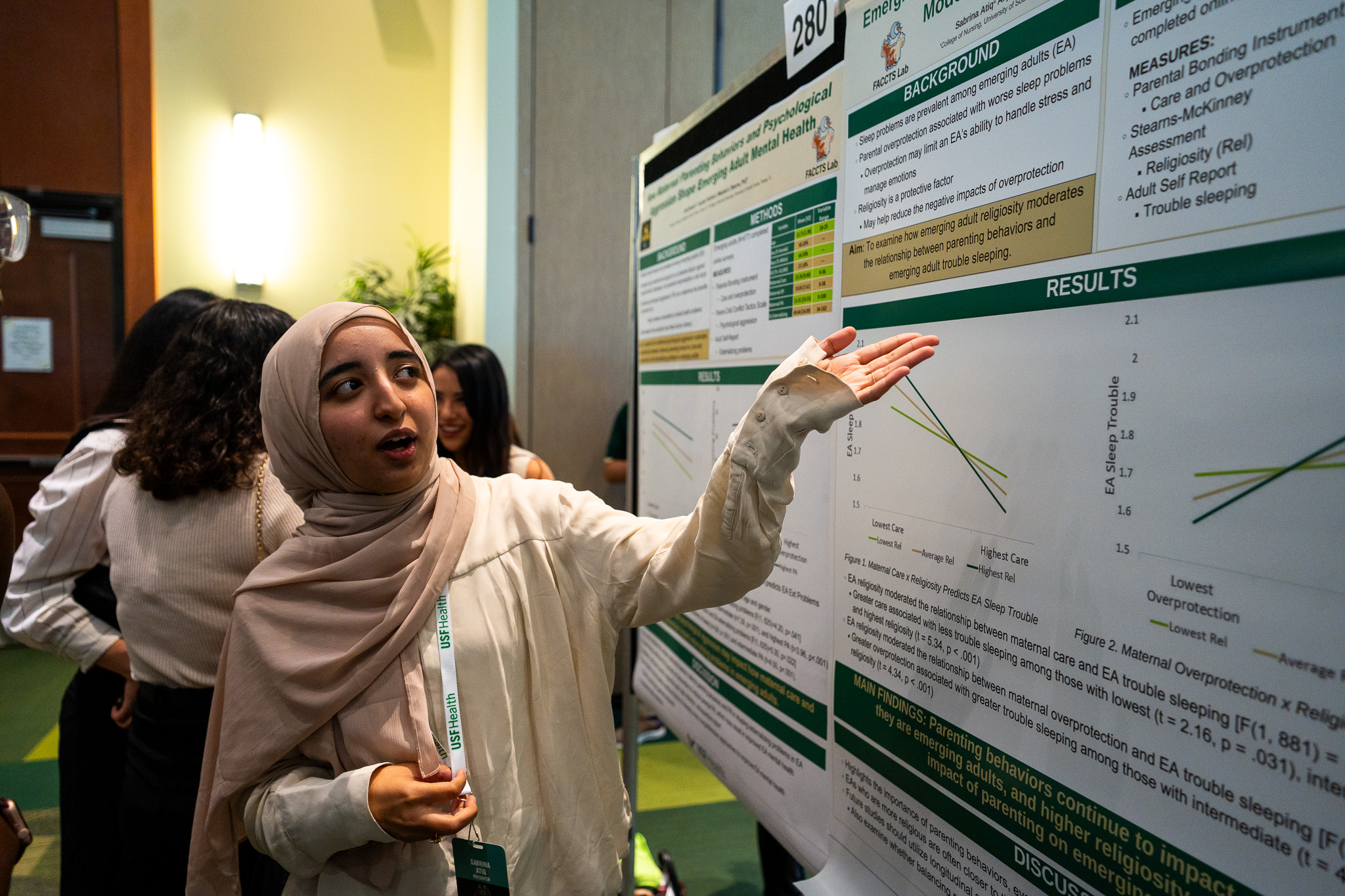
Doctor of Nursing Practice Poster Showcase
Explore the work of past students by browsing completed projects, research topics, and titles from previous cohorts. From theses and dissertations to capstone projects and scholarly publications, these examples showcase the creativity, dedication, and academic excellence of our graduates.