MedEd Symposium
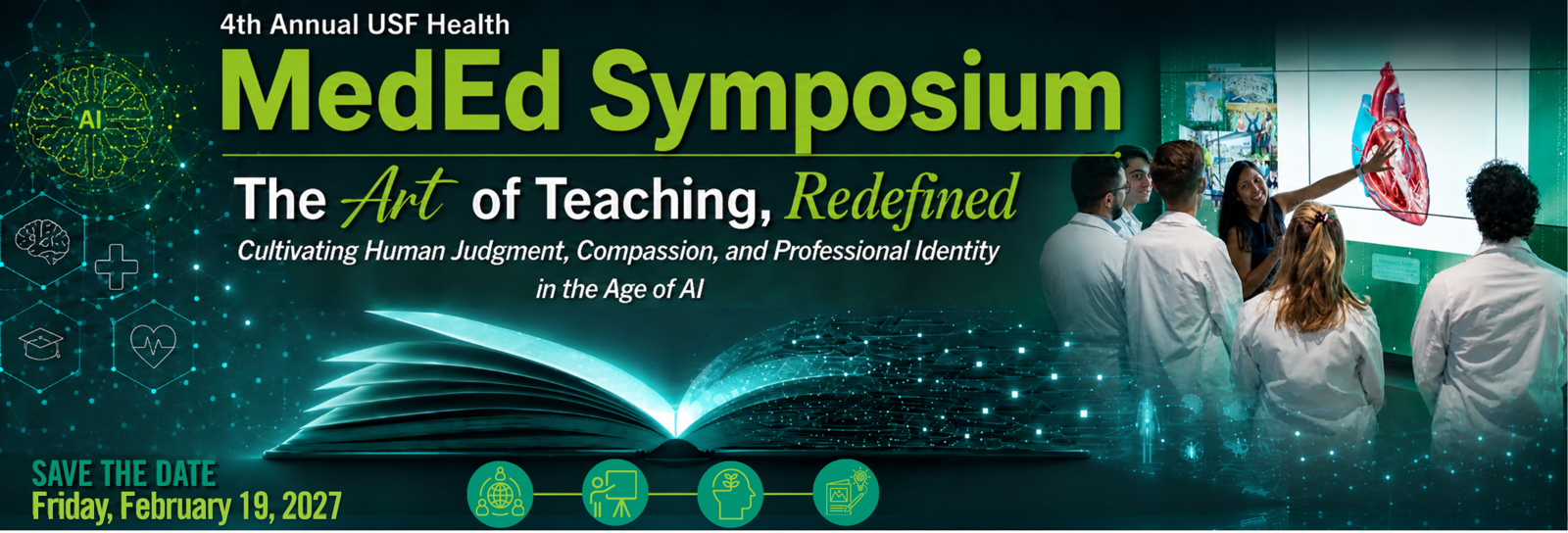
Join us at the 2027 MedEd Symposium | Friday February 19, 2027
Calling all educators, clinicians, trainees and health professional students from USF Health and our HCA GME consortium!
WORKSHOP PROPOSAL DEADLINE OCT 10TH!
Reminder - the deadline for workshop proposals is fast approaching.
Please submit abstracts for workshops by end of day Oct 10th. See more information below.
Theme: The Art of Teaching, Redefined: Cultivating Human Judgment, Compassion, and Professional Identity in the Age of AI
This will be an enriching day with concurrent workshops, poster presentations, and a showcasing of scholarly projects and creative expressions centered around our theme.
Come explore how health professions educators can cultivate the uniquely human dimensions of learning in an era increasingly shaped by artificial intelligence.
Conference Location
USF Health Morsani College of Medicine (MCOM)
Four Exciting Ways to Participate!
We’re seeking compelling examples of innovative teaching, reflective practice, and systems-based solutions. Ways you can present your education-related scholarly work:
Lead a workshop
Present a poster in 2 categories - Innovations and Research
Showcase a Creative Expression
Do a Shark Tank-style Ace Pitch! for project support
Topics of interest include, but are not limited to:
Artificial Intelligence & Educational Innovation
Clinical Reasoning & Human Judgment
Compassion, Communication & Human Connection
Professional Identity Formation & Professionalism
Teaching Excellence & Faculty Development
Assessment, Competency & Entrustment
Interprofessional Education & Team-Based Care
Educational Scholarship, Ethics & the Humanities
Submission deadlines:
October 10, 2026- Workshop Proposals - informed of acceptance mid-November
December 5, 2026 - Abstracts (IME or RIME Posters, Creative Expression, Ace Pitch!) - informed of acceptance mid-December
To submit:
Click the category below to download and complete the abstracts
Save final document as your abstract title
Upload the completed abstract to the submission survey
Abstract Links
-
Workshop Proposal - Due Oct 10th
A 60-minute interactive workshop designed to engage participants actively and leave them with take-home strategies or frameworks they can apply in their own settings.
-
Poster - Innovations in Medical Education (IME) Abstract - Due Dec 5th
Purpose: To promote dissemination and discussion of educational innovations. Criteria: 2000 character (max) abstract.
-
Poster - Research in Medical Education (RIME) Abstract - Due Dec 5th
Purpose: To promote dissemination and discussion of research and its application to medical education. Criteria: 2000 character (max) research abstract
-
Creative Expression Abstract - Due Dec 5th
Purpose: To disseminate creative ideas in medical education, including medical arts and humanities, narrative, visual, and other expressions to support medical education. Participants accepted to present in this category will have a platform to showcase their creative works in innovative ways. Criteria: 2000 character (max) abstract
-
Ace Pitch! Abstract - Due Dec 5th
Purpose: To cultivate new ideas rooted in good educational practice, and support scholarly development. A "Shark Tank"-like presentation, participants accepted to present in this category compete with each other to qualify for up to $1500 in seed funding. Criteria: 2000 character (max) abstract.
-
The ACE Pitch! session showcases innovative educational ideas with the potential to advance health professions education. Applicants will submit a brief proposal and selected finalists will present their ideas during a live symposium session.
Up to three ACE Pitch! awards will be granted, each providing up to $1,500 in seed funding to support project implementation. Awardees will also receive mentorship from senior education leaders who will provide coaching and guidance as projects move from idea to execution.
Projects may include curricular innovations, assessment strategies, faculty development initiatives, AI-enabled educational tools, learner support programs, scholarly educational projects, or other creative approaches to improving health professions education.
The ACE Pitch! Award is intended to help promising ideas gain the resources, mentorship, and momentum needed to make a meaningful impact.
Guidelines for Writing IME/RIME Abstracts
-
An abstract:
- Is a condensed version of a full research/innovation description paper.
- Provides reviewers a brief synopsis of innovation/research purpose, design, findings to date and implications.
- Focuses on primary issues of why the work was done, how it was/is carried out, what was found, and what the potential implications are.
- Is written clearly with strict adherence to published specifications and format requirements.
- Is proofread carefully.
Let's take a closer look at each Abstract section and how the following questions should be answered.
-
- Provide a context or explanation for doing the study/innovation.
- State the aim of the study/innovation.
- Show relevance of the work to the field.
-
- Introduce the design/approach of the study/innovation.
- State the context in which it was done and who participated.
- Describe how the study/innovation was executed (including data sources and analysis).
-
- Include key data/outcomes that flow from previous sections and from which you will draw your conclusions.
- Do not include interpretations.
- Report descriptive data (response rate, final pool of participants), inferential values with p values, functional significance (effect size), and/or emergent themes and sub‐themes, if applicable.
- A table or figure may be included if permitted and it conveys the findings of the study/innovations more effectively than text alone.
-
- Interpret results.
- State the implications/importance of the results.
- Relate to the purpose of the study/innovation.
-
- Convey as much as possible about context and aims of your study.
- Alert readers to the overall “take‐home message.”
- Describe what was investigated/done rather than to state results or conclusions.
- Don’t use jargon, or unfamiliar acronyms
- Include key aspects of study/innovation design
-
- Use simple declarative sentences; active voice is preferable to passive voice.
- Spell out all but the most commonplace abbreviations or acronyms the first time they appear.
- Re‐read the instructions before printing the final onto the submission form, and to make sure they have been followed to the letter.
- Avoid grammatical mistakes, misspelled words, or typographical errors.
- Read colleagues’ accepted abstracts and/or published abstracts from recent meetings (if they are available).
-
- The list of authors should be restricted to those individuals who actually did the study— conceived it, designed it, gathered the data, crunched the numbers, and wrote the abstract.
- Author lists are rough rank orders of the relative contributions of the persons named, with the exception that the senior author (the mentor) is often listed last.
- The author listed first is the person who conceived the study and did most of the creative work on the project. With few exceptions, this should be the person who will present the abstract, if it is accepted.